Guide
How Much to Charge for a Cake: A Simple Pricing Formula (With an Example)
Price a homemade cake with one formula: ingredients, packaging, overhead, your time and profit. A worked 8-inch example, price per slice and a serving chart.
 By Mina, Sorted Templates · November 4, 2026 · 5 min read
Most home bakers start by charging what feels “fair”, which usually means ingredients plus a little extra. That price leaves out your time, your oven, your boxes and the hour you spent messaging the customer. A cake price that covers all of it comes from one formula.
The cake pricing formula
Price = ingredients + packaging + overhead + your time + profit
- Ingredients: only the amount the cake actually uses, not the whole bag.
- Packaging and decorations: cake board, box, dowels, toppers, ribbon, sprinkles, gold leaf.
- Overhead: your share of power, gas, equipment wear, card and platform fees. Many bakers add 10–20% of ingredients and packaging.
- Your time: every hour, at an hourly rate you’d accept for any other job.
- Profit: what the business keeps on top of paying you, for new pans, slow months and growth. A common starting point is 20% of the cost.
If you deliver, add delivery as a separate line, so it doesn’t change your price per slice.
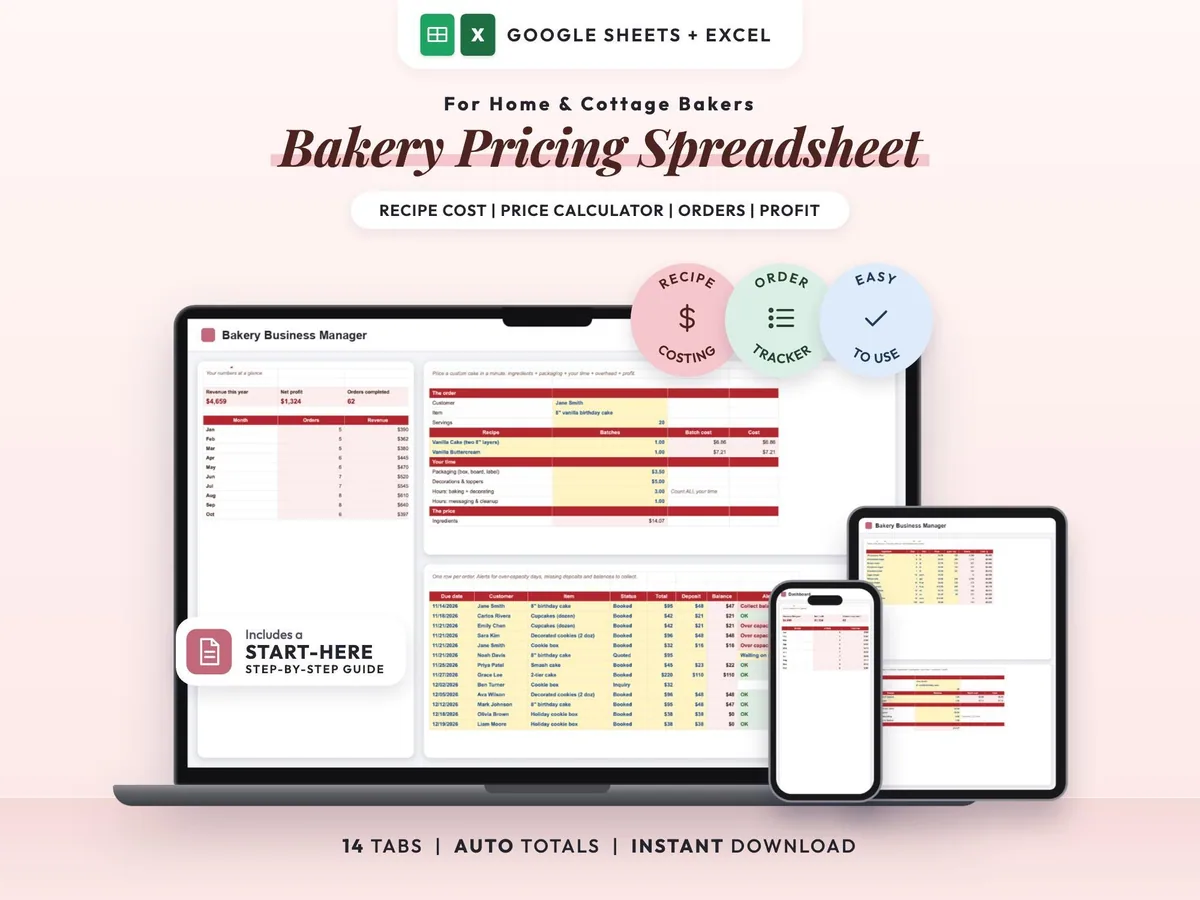
Do it in a minute: our free cake pricing calculator runs this formula for you, converts package sizes to the amount you used and shows the price per slice.
Step 1: Work out what the ingredients cost
Divide what you paid for each package by its size, then multiply by the amount the recipe uses.
For example, a 5 lb (80 oz) bag of flour at $4.00 costs $0.05 an ounce. If the recipe uses 12 ounces, the flour in this cake costs $0.60. Do the same for butter, sugar, eggs, milk, cocoa, vanilla and so on, and add them up.
It’s tempting to skip the small things, but vanilla, food coloring, chocolate and fresh fruit add up quickly. Write them down once and reuse the numbers for every cake.
Step 2: Count all of your time
Your time is usually the biggest part of a cake’s price, and the part most often left out. Count:
- shopping for ingredients
- baking, cooling, filling and stacking
- decorating
- washing up
- answering messages, quoting and invoicing
- packing and handover
A cake that is “two hours of baking” is often closer to three or four hours from the first message to handover.
What hourly rate? At least what you could earn in a job nearby. If you wouldn’t take a job at $10 an hour, don’t bake for $10 an hour.
Step 3: Add overhead and profit
Overhead covers the costs that don’t belong to one cake: electricity and gas for the oven, mixer and pan wear, card fees and website or platform fees. Adding a percentage, such as 15% of ingredients and packaging, is simpler than tracking every bill.
Profit is separate from your wage. Your hourly rate pays you for the work. Profit pays the business, so it can buy a new stand mixer or cover a slow January without you working for free.
A worked example: 8-inch round cake
Here’s a two-layer 8-inch round with buttercream and a simple piped finish:
| Line | Amount |
|---|---|
| Ingredients | $14.00 |
| Board, box and decorations | $4.00 |
| Overhead (15% of $18.00) | $2.70 |
| Your time: 3 hours × $20 | $60.00 |
| Cost | $80.70 |
| Profit (20% of cost) | $16.14 |
| Price (rounded up) | $97 |
An 8-inch round cuts into about 16 party slices (1.5 × 2 inches) or 25 wedding slices (1 × 2 inches). That makes it about $6.06 a slice for a party cake, or $3.88 if it’s cut wedding-style.
If $97 feels high, look at what is driving it. Here it’s the time. The fix is to work faster with a set menu of designs, or to charge more for the designs that take longest. Cutting your hourly rate means you pay for the cake yourself.
How many servings does a cake have?
Servings depend on the slice size. Bakers use two common cuts for tiers about 4 inches tall: wedding slices of 1 × 2 inches and party slices of 1.5 × 2 inches. These are the servings per tier:
| Tier size | Round, party | Round, wedding | Square, party | Square, wedding |
|---|---|---|---|---|
| 6 inch | 9 | 14 | 12 | 18 |
| 8 inch | 16 | 25 | 21 | 32 |
| 10 inch | 26 | 39 | 33 | 50 |
| 12 inch | 37 | 56 | 48 | 72 |
For a tiered cake, add the tiers together. A 6-inch on an 8-inch round serves about 39 at wedding cut. The cake pricing calculator has a serving calculator for any tier sizes.
Price per slice or price per cake?
Customers think in people, so many bakers price by the serving: “$4 a serving for buttercream, $5 for fondant”. This works well as long as your per-serving price comes from the formula above, not from a guess. Run the formula on your two or three most popular cakes, divide by their servings, and use that as your base price per serving.
Set a minimum order too. A 6-inch cake takes almost as much time as an 8-inch, so it can’t be priced at half.
Common pricing mistakes
- Pricing from the ingredients only. Ingredients are often less than a quarter of a fair cake price.
- Copying the bakery down the road. Their costs, rent and skills aren’t yours. Use local prices to check your number, not to set it.
- Forgetting the small costs: boards, dowels, boxes, card fees, and the gas to deliver.
- Discounting for friends every time. Decide on a friends-and-family price once, and stick to it.
- Never raising prices. Recheck your ingredient costs every few months. Butter, eggs and chocolate change price often.
Before you sell
Selling food from home is covered by cottage food rules, which vary by state and country: what you can sell, where, and what your labels must say. Check your local rules before you take orders. This guide is about pricing, not legal advice.
Keep it consistent
The easiest way to price every order the same way is to keep the formula in one place: a spreadsheet with your ingredient costs, your hourly rate and your margins. Then each new quote takes a minute, not an evening.
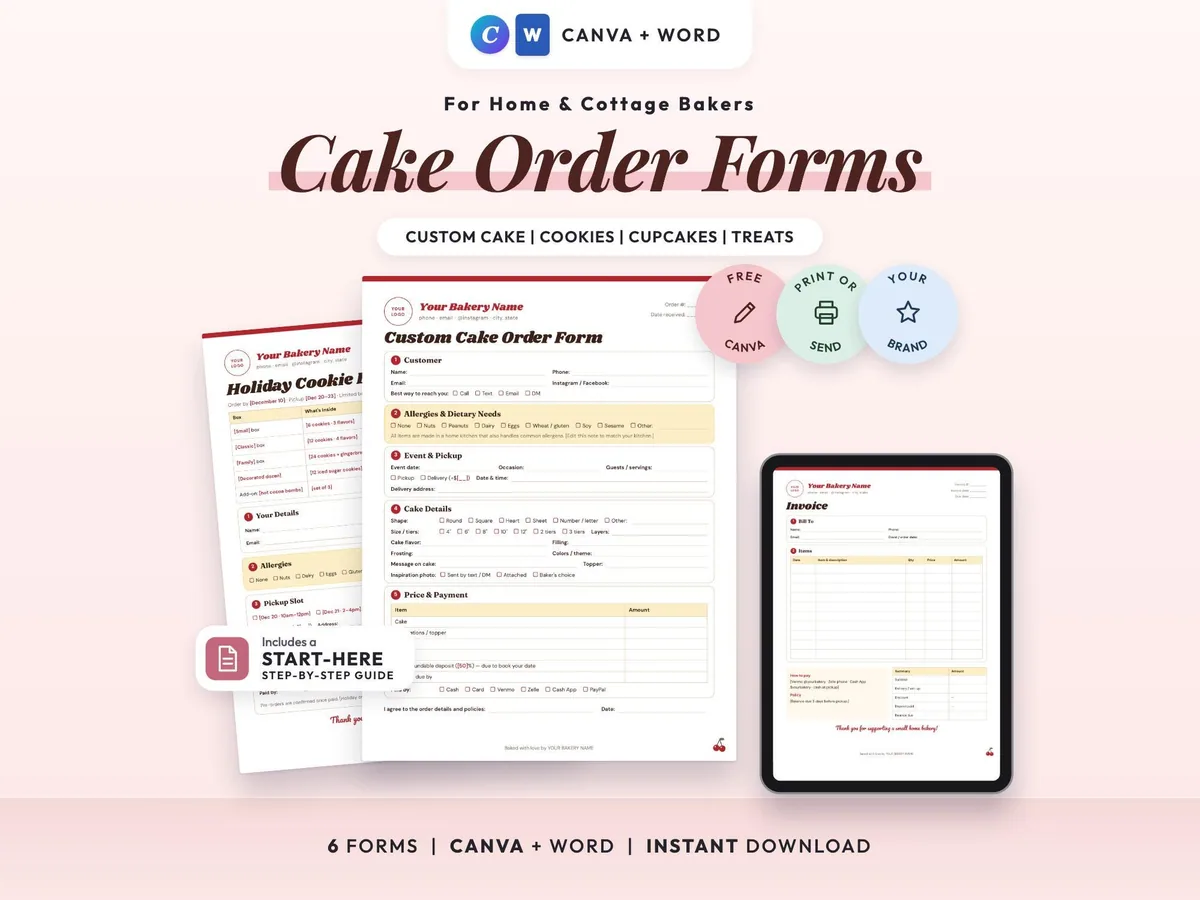
When the price is agreed, put it in writing with a simple order form that has the design, servings, pickup date and deposit.
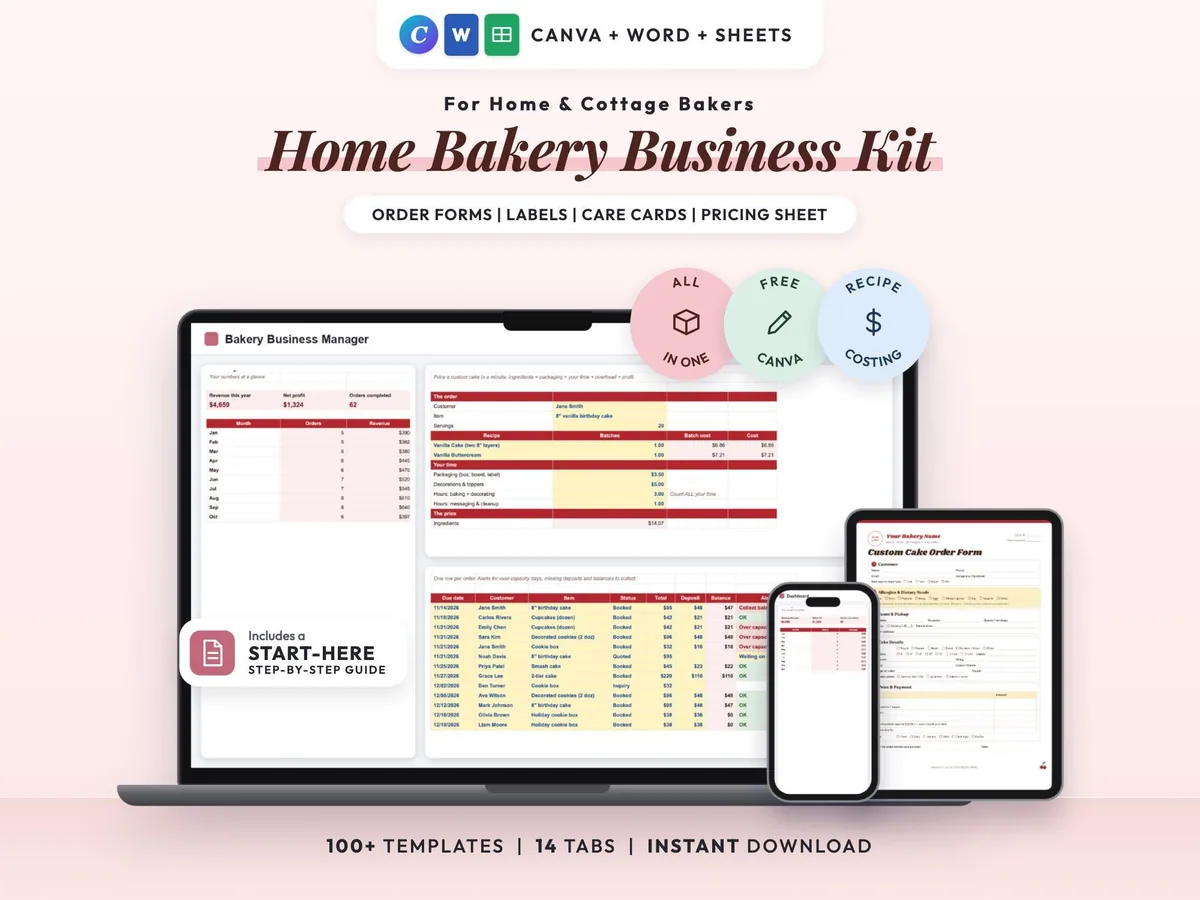
Starting a home bakery from scratch? The full kit has pricing, order forms, labels and policies together.
How we write guides: drafted with help from AI tools, then checked, edited and tested by us against our own templates. Spotted something wrong? Email [email protected].