Guide
Every Other Weekend Custody Schedule: How It Works, Percentages and Common Versions
How an every other weekend custody schedule works: Friday to Sunday or Monday, adding a midweek overnight, the 1st, 3rd and 5th weekend plan, holidays and the time split.
 By Mina, Sorted Templates · November 4, 2026 · 5 min read
In an every other weekend schedule, the children live with one parent during the week and spend alternate weekends with the other. It’s one of the most common plans when one parent has the school week, and it comes in a few versions that change the time split a lot.
This is a plain explanation of how these schedules work, not legal advice. Your custody order or parenting plan is what counts, and an attorney or mediator can tell you what fits your case.
What every other weekend looks like
A is the parent with the school week and B has alternate weekends. Each letter is one overnight, Monday to Sunday:
| Version | Week 1 | Week 2 | B’s overnights in 14 | B’s share |
|---|---|---|---|---|
| Friday to Sunday | A A A A B B A | A A A A A A A | 2 | about 14% |
| Friday to Monday morning | A A A A B B B | A A A A A A A | 3 | about 21% |
| Friday to Sunday + Wednesday overnight | A A B A B B A | A A B A A A A | 4 | about 29% |
| Friday to Monday + Wednesday overnight | A A B A B B B | A A B A A A A | 5 | about 36% |
Over a year, that’s roughly 52, 78, 104 or 130 overnights with parent B.
See your own year: the free every other weekend calendar colors every weekend for 12 months from your start date and counts the overnights for each parent.
Friday to Sunday
The plain version: parent B picks the children up on Friday after school or work and brings them back on Sunday evening. That’s Friday and Saturday nights, two overnights out of every fourteen.
Why families pick it: the school week stays in one home, it’s easy to remember, and it works when the parents live far apart.
The catch: there are twelve days between visits, which is a long time for young children. The Sunday evening handover also means a school night starts with a move.
Friday to Monday morning
Parent B keeps the children on Sunday night and takes them to school on Monday morning. This adds a third overnight, which takes B’s share from about 14% to about 21%, and the exchange happens at school instead of face to face.
This is also the version most people mean by an 80/20 schedule. You can see a year of it with the 80/20 custody calendar.
Adding a midweek visit
The twelve-day gap is the main complaint about every other weekend, so many plans add a midweek visit with parent B:
- A Wednesday overnight every week brings B’s share to about 29%, and the children are never more than six nights in a row away from either parent. See the every other weekend and Wednesday calendar.
- A Wednesday dinner (for example, after school until 7 pm) keeps the contact without a school-night move. Dinners don’t count as overnights, so the split stays at the weekend-only number.
With a Friday to Monday weekend and a Wednesday overnight, B has five nights in fourteen, about 36%. That’s close to the 60/40 and 70/30 schedules, which you can compare in the 60/40 and 70/30 calendars.
Every other weekend vs the 1st, 3rd and 5th weekends
Some parenting plans don’t strictly alternate. Instead they give parent B the 1st, 3rd and 5th weekends of each month, counted by the Fridays.
The difference shows up in months with five Fridays. Strict alternating gives 26 weekends a year. The 1st, 3rd and 5th plan gives parent B 29 weekends in 2027, because January, April, July, October and December 2027 each have five Fridays. It also means B sometimes has two weekends in a row, at the end of one month and the start of the next.
Check which one your plan says. The words “every other weekend” and “the first, third and fifth weekends” sound alike but give different calendars.
Holidays and summer
Most plans set a holiday schedule that overrides the regular weekends. Common patterns are:
- alternating Thanksgiving and other major holidays each year
- splitting Christmas Eve and Christmas Day
- Mother’s Day and Father’s Day with that parent, whatever the weekend
- a long weekend with parent B when a Monday holiday falls on their weekend
- one or more weeks in a row with parent B in the summer
Summer weeks and holidays can change the yearly split a lot, especially for the weekend parent. Put them on the calendar at the start of the year, so nobody is surprised in November.
Is every other weekend fair?
It depends on the family. It suits parents who live far apart or have work hours that make school runs hard. It can feel thin for the weekend parent, who misses homework, school events and ordinary weeknights.
If the gap feels too long, the usual next steps are a midweek dinner, then a midweek overnight, then a Monday morning return. Each step adds time without moving the school week. Many families change the plan as the children grow, which is easier with a record of how the current one is going.
How to keep track
A written record saves arguments and helps if the plan is ever reviewed:
- the calendar, with every weekend and holiday
- swaps and missed visits, with the date and the reason
- exchange times and any problems at handover
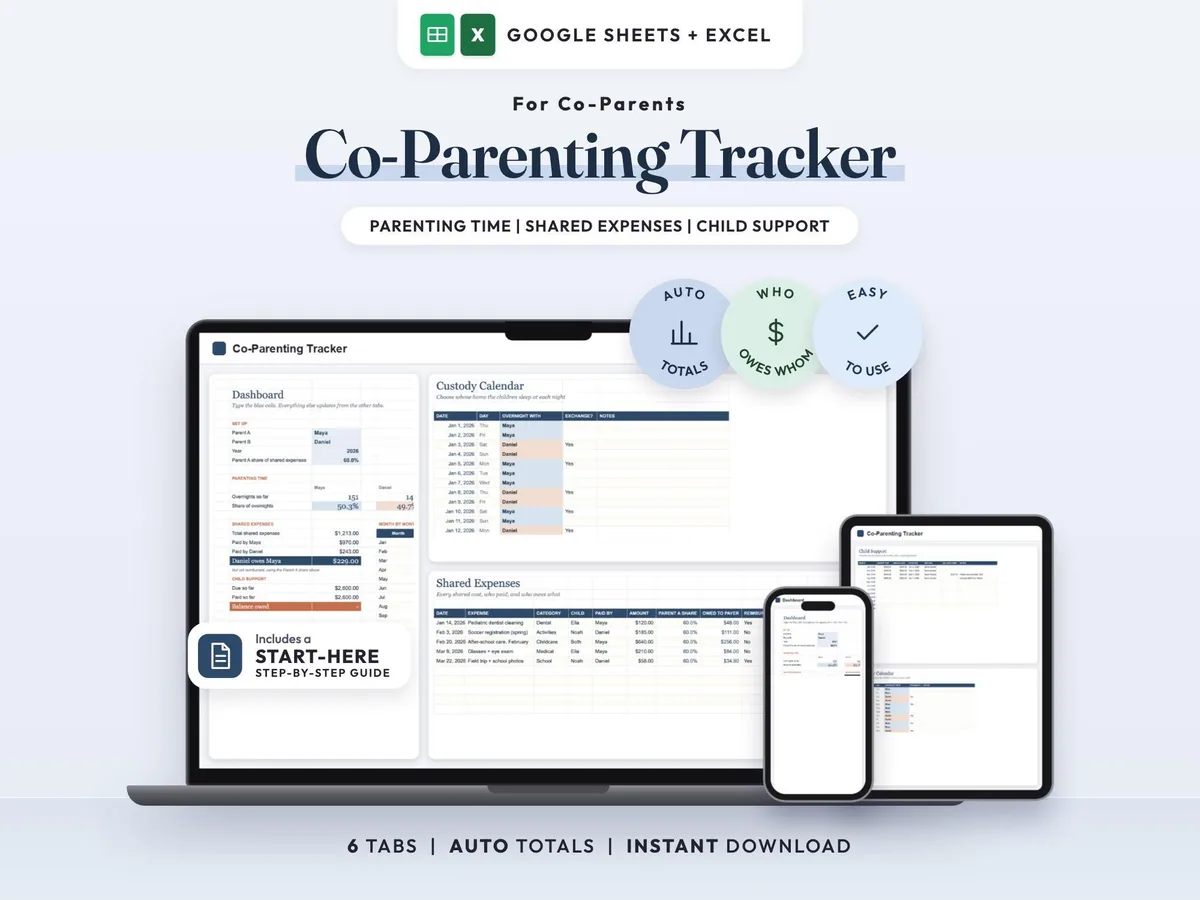
- shared costs and who paid them
If parenting time affects child support where you live, ask how your state counts it. Some count overnights, others count hours or days.
How we write guides: drafted with help from AI tools, then checked, edited and tested by us against our own templates. Spotted something wrong? Email [email protected].