Guide
50/50 Custody Schedules Explained: 2-2-3, 2-2-5-5, 3-4-4-3 and Week On/Week Off
How the four common 50/50 custody schedules work, with two-week calendars, overnight counts, and the pros and cons of each. Plus how to track it.
 By Mina, Sorted Templates · October 25, 2026 · 6 min read
A 50/50 custody schedule gives each parent the children for half of the overnights, and there’s more than one way to split them. The four schedules below are the ones families use most. They only differ in how often the children move and how long they’re away from each parent.
This is a plain explanation of how the schedules work, not legal advice. Your custody order or parenting plan is what counts, and an attorney or mediator can tell you what fits your case.
The four 50/50 schedules at a glance
Each row below is the same two weeks, Monday to Sunday. A and B are the two parents, and every letter is one overnight.
| Schedule | Week 1 (Mon–Sun) | Week 2 (Mon–Sun) | Longest stretch away |
|---|---|---|---|
| Week on / week off | A A A A A A A | B B B B B B B | 7 days |
| 2-2-3 | A A B B A A A | B B A A B B B | 3 days |
| 2-2-5-5 | A A B B A A A | A A B B B B B | 5 days |
| 3-4-4-3 | A A A B B B B | A A A A B B B | 4 days |
All four give each parent 7 overnights out of every 14, which works out to about 182 or 183 nights a year.
See your own year: our free custody calendar maker turns any of these schedules into a color-coded 12-month calendar, with holidays and overnight counts, that you can print.
Week on / week off (7-7)
The children spend a full week with one parent, then a full week with the other. The handover is usually on the same day every week, often Friday after school or Sunday evening.
Why families pick it: there’s only one exchange a week, it’s easy to remember, and it suits older children and teenagers who don’t want to pack a bag every few days.
The catch: seven days is a long time apart for young children, and if the parents live far apart, the weekly school run can be hard. Some families add a midweek dinner with the other parent to break up the week.
The 2-2-3 schedule
Parent A has Monday and Tuesday, Parent B has Wednesday and Thursday, and Parent A has the weekend from Friday to Sunday. The next week flips, so Parent B starts with Monday and Tuesday and gets the long weekend.
Why families pick it: the children are never more than three days away from either parent, which is why it’s often suggested for toddlers and young school-age children.
The catch: there are three exchanges a week, and the weekdays change from week to week, so it takes a shared calendar to keep track of. It works best when the two homes are close together and the parents can manage frequent handovers calmly.
The 2-2-5-5 schedule
Each parent keeps the same two weekdays every week. For example, Parent A always has Monday and Tuesday and Parent B always has Wednesday and Thursday. The weekends alternate and attach to the weekdays, so each parent gets a five-day stretch every other week. It’s also called the 5-2-2-5 schedule.
Why families pick it: fixed weekdays make activities and work schedules easier, because Tuesday soccer is always with the same parent. There are fewer exchanges than with 2-2-3, and they often happen at school, so the children don’t see a handover at all.
The catch: the five-day stretch can feel long for very young children.
The 3-4-4-3 schedule
In week one, Parent A has three days and Parent B has four. In week two, it reverses: Parent A has four and Parent B has three. In the table, that means Parent A always has the start of the week and the switch day moves from Thursday to Friday.
Why families pick it: it has fewer exchanges than 2-2-3 but shorter stretches than week on/week off, a middle ground for children who do well with routine.
The catch: the switch day moves between weeks, which takes some getting used to. Laid out like this, one parent also gets every weekend, so many families rotate the start day or trade weekends to share them.
How families usually choose
There is no single best schedule, but a few questions come up in almost every family:
- How old are the children? Shorter stretches (2-2-3) are common for young children. Longer ones (week on/week off) are common for teenagers.
- How far apart are the homes? Frequent exchanges are only realistic if both homes are close to school.
- How do exchanges go? If handovers are tense, a schedule with fewer of them, or exchanges at school, keeps the children out of the middle.
- What about work shifts and activities? Fixed weekdays (2-2-5-5) make regular commitments easier to plan around.
Many families start with one schedule and change it as the children grow, which is easier when you have a record of how the current one is going.
What about holidays and summer?
Most parenting plans set a separate holiday schedule that overrides the regular one: for example, alternating Thanksgiving every year, splitting Christmas Eve and Christmas Day, and giving each parent one or two weeks in a row in the summer. Write the holiday dates on your calendar at the start of the year, so nobody is surprised in November.
How to keep track of a 50/50 schedule
Whatever schedule you use, a written record saves arguments and helps if the plan is ever reviewed:
- Put the whole year on one calendar. Mark each night with A or B, plus the holiday exceptions. A printed calendar on the fridge also helps the children see where they’ll be.
- Log every exchange. The date, time, place and anything unusual, written on the day.
- Keep a communication log. What was agreed, and when.
- Track shared costs. Activities, school fees and medical costs, with who paid and the agreed split.
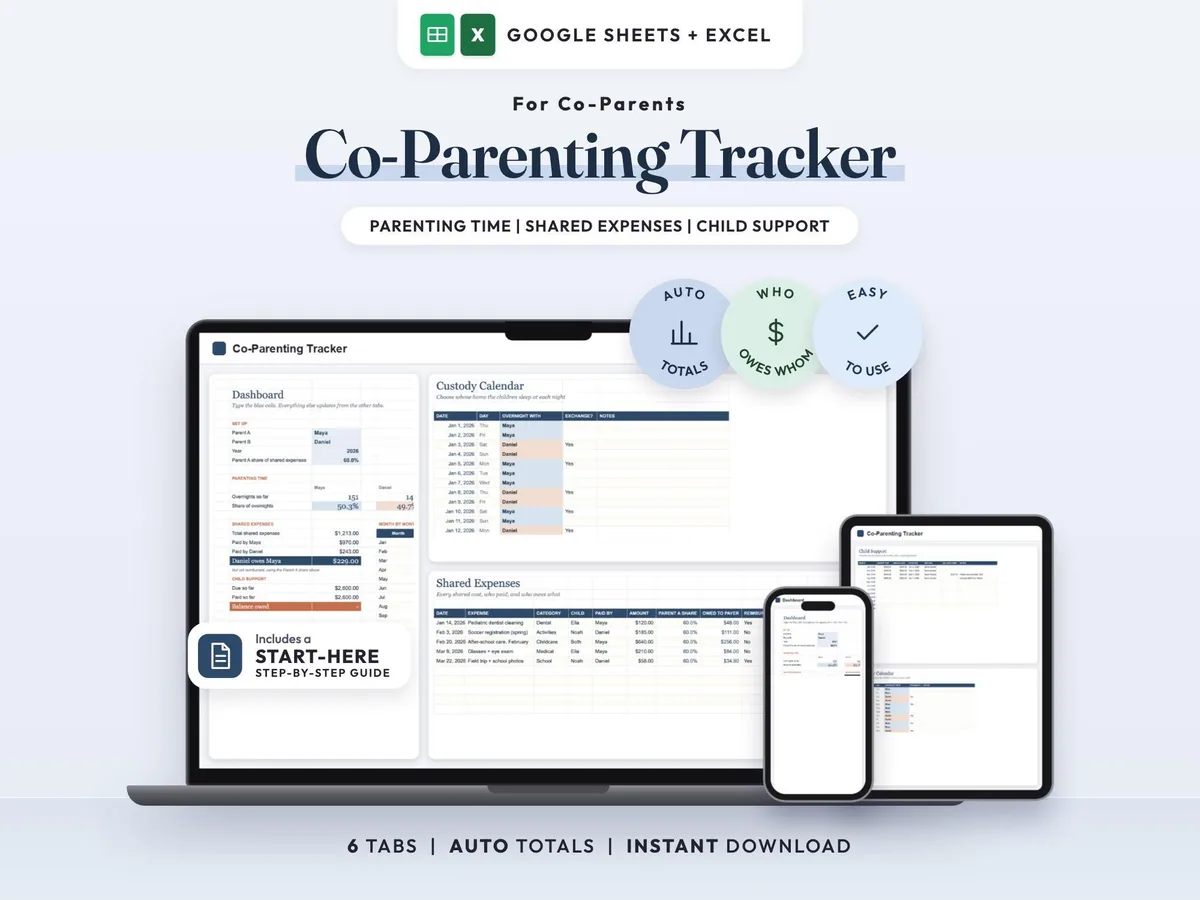
Our Two Homes custody binder has a page for each of these, including 12 monthly custody calendars, and the co-parenting spreadsheet counts the overnights and parenting time percentage for you as you fill in the calendar.
Quick answers
Is 2-2-3 or 2-2-5-5 better? Neither is better in general. 2-2-3 keeps the time apart shorter. 2-2-5-5 keeps the weekdays the same every week and has fewer exchanges.
How many overnights is 50/50? 7 out of every 14 nights, or about 182 to 183 a year.
What is a 60/40 schedule? One parent has roughly 4 of every 7 nights, for example a 4-3 split each week, or alternating weekends extended to Monday morning plus one weekday overnight.
Does 50/50 custody mean no child support? Not necessarily. Support depends on your state’s rules and each parent’s income, so ask your attorney or your state’s child support office.
How we write guides: drafted with help from AI tools, then checked, edited and tested by us against our own templates. Spotted something wrong? Email [email protected].